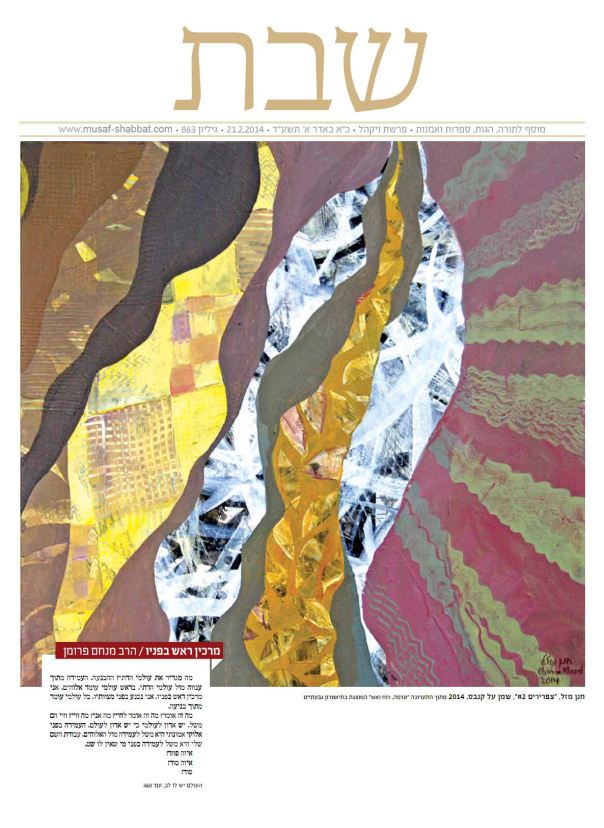
My artwork on the cover of Makor Rishon’s literary magazine


Gouache and various point media, 20 x 20 cm on paper (8″ x 8″ for you Yanks)
Experiments in color and gouache techniques, perhaps studies for bigger works on canvas.
My wife Adina has a healthy sense of humor. Thus, she declared the earliest of these scribbles to be Mapiot/Napkins, due to their being the exact size of fancy paper napkins. To be honest, the birth of the series was equally domestic: A great sale on small square watercolor paper pads. (Us ex-New Yorkers can’t resist a bargain.)
After 25 years designing and publishing greeting cards, and painting on a tiny scale, a few years ago I felt a need to work LARGE, with BIG arm movements. I jumped to 40 x 60 cm formats, and by last year, I had moved on to wall sized canvases. It was exhilarating, and released an explosion of creative adventure. But the down side of my afore mentioned thriftiness, is my fear of wasting a perfectly good $40 canvas on a loony or ugly experiment. Even worse, is my fear of wasting 2 weeks of hard work, compounded by the headache of storing dozens of monster canvases of questionable quality.
Working small:
Abruptly changing the size of my formats, was once again liberating. In this new reduced size, I can quickly try an idea over and over again, with different approaches. I dare to be “ugly” while free from thinking, “But who will buy this?” I’ve been burning through those pads in a creative frenzy!
As I have written often before, I am attracted to both the ornament and the kind of conventional “prettiness” which is accessible to most viewers — and to expressive work with deep, dark secrets. For the past 3 years, I have been working on ways to engage the two together. Often, the outward subject is simple and easy to live with, like a bowl of fruit. But none of us are really that simple and live easily with ourselves… And heck! Painting my wild undertones, is a lot cheeper than psychotherapy! Anyway – I just enjoy painting these spontaneous squares.
A second goal has evolved during the process; exploring the border zone between drawing and painting. So far, I have used point medias to create a delightful chaos on the page, and more serene, brush applied gouache in ornamental patterns. Layer upon layer. I plan to pursue this further.
A video prepared for my summer workshop “Diving Into Colour”
וידאו שהכנתי עבור סדנת היצירה “צלילה לעולם הצבע” קיץ 2013
Interview about my 2013 show “Ongepatchket” Part of CultureBuzz project of the Foreign Ministry of Israel, by Aviad Ivri
CultureBuzz is a wonderful online video project sponsored by the Foreign Ministry of Israel. Many thanks to Aviad Ivri!

Sneak Preview of the exhibit “Ongepatchket” at the Jerusalem Theatre, open till June 11, 2013
מבט חטוף אל התערוכה “אָנגעפאטשקאט | נקוד וטלוא” בתיאטרון ירושלים, עד 11.6.2013
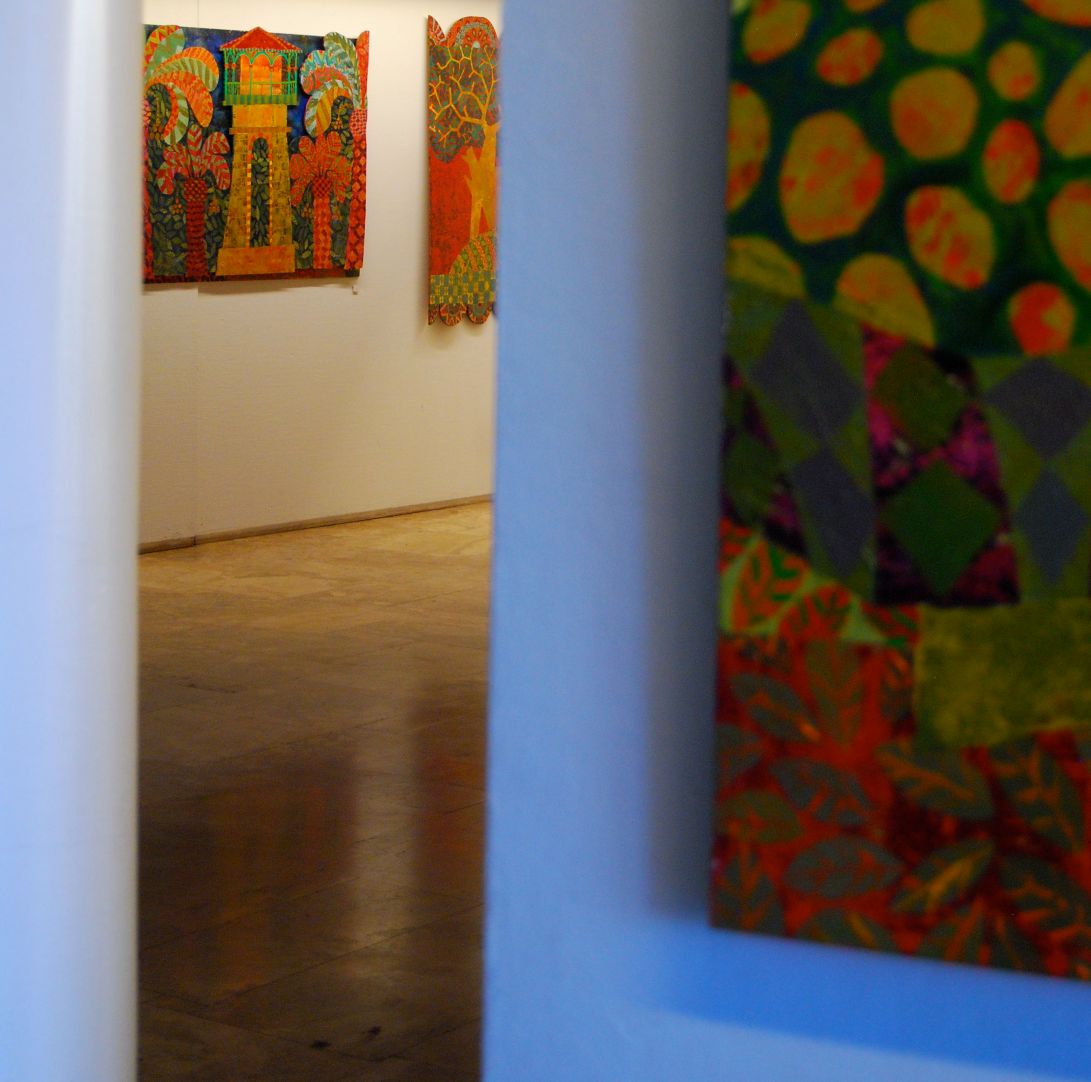
Ongepatchket | נָקֹד וְטָלוּא| אָנגעפאטשקט
When Jacob negotiated with his nasty father-in-law Laban, he chose the decorative spotted and patched sheep and goats as salary. He left those with Minimalist aesthetics for his in-laws. Indeed, Jacob showed talent at encouraging the flock to reproduce with even more resplendent patches.
Following our forefather’s example, I explore the world of pattern and ornament, as a vehicle of artistic, emotional and ideological expression.
I had my first encounter with patchwork when my Mom gave me some old wallpaper catalogs. My scissors and glue had always worked overtime, but the mess was more than she expected. In desperation, she cried, “Stop patchkying around!”
Patchkerei: Yiddish for making a big fuss with lots of details. From Old German patch.
Mom often dragged me to antique shops valuing my 8 year old opinion. Victorian treasures and monstrosities could still be purchased for pennies. If something was particularly dripping with poorly applied ornament, we would laugh,
“It’s sooooo ongepatchket!”
Ongepatchket: Yiddish, over decorated, fussy.
So how do all of these stories “patch” together?
I am an artist creating HERE – in our noisy, colorful, intimate, dressed-in-schmattes Holy Land.
I often work by layer upon layer of patterned patches; ripping and unraveling the image, then gently “sewing” it together. I like paintings with something missing, spontaneous, with a turbulent undercurrent, yet somehow full of joy.
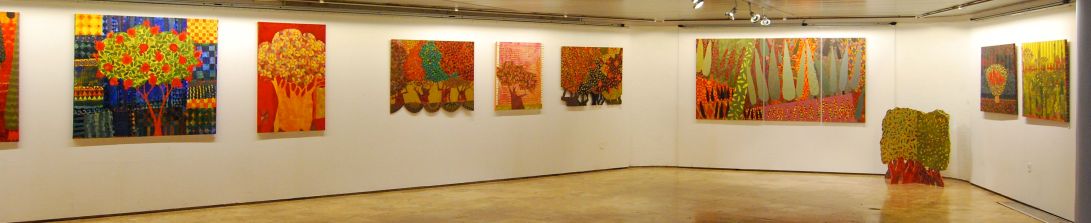
Ongepatchket | נָקֹד וְטָלוּא| אָנגעפאטשקט
יעקב אבינו בחר כשכרו את כל העזים המקושטות, והשאיר ללבן הארמי את אלו בעלות האסתטיקה המינימליסטית. שנאמר ״הָסֵר מִשָׁם כָּל-שֶׂה נָקֹד וְטָלוּא וְכָל-שֶׂה-חוּם בַּכְּשָׂבִים, וְטָלוּא וְנָקֹד, בָּעִזִּים; וְהָיָה, שְׂכָרִי״.
פירש רש״י: וְטָלוּא – לשון טלאי, חברבורות רחבות.
בינקותי חיסלתי קטלוגים של טפטים בעבודות טלאים, patchwork בלע״ז. מספריים ודבק עבדו אצלי שעות נוספות ופיסות נייר מילאו את חלל הבית. מחברות הלימודים היו גדושות בשרבוטים גיאומטריים. אמי ז״ל כינתה בלגאנים ויצירות אלו ״פאטשקעריי״, ונהגה לקרוא בייאוש “!Stop patchkying around”- די להתפצ’קר!
פאטשקעריי: מילה משעשעת ביידיש, עבודה עם המון פרטים, שלבים וטירחה. שורש פאטש – טלאי בגרמנית, דומה לpatch בלע”ז.
בילדותי אמי נהגה לסחוב אותי לחנויות ענתיקעס. היו מציאות ויקטוריאניות חמודות, והיו מזעזעות עם הררי קישוט וקצפת מתוקה, שהביאו אותנו להתגלגל מצחוק,“!It’s soooo ongepatchket”
אנגעפאטשקעט, לשון ״פאטש״ – טלאי: מקושט ומיופה מדי. עמוס בטעם רע.
אז מה הקשר בין טלאים לעבודותיי המוצגות כאן?
אני אמן שחי פה, בארצנו הססגונית, הקדושה ,הלבושה בשמאטעס, בוויכוח עם עולם האמנות הגדול והנאור.
אני מרבה לצייר טלאי על טלאי, בקרעים קשים ובתיקונם ברוגע ואהבה. אני אוהב ציור שמשהו חסר בו, ספונטני, סוער, ובכל זאת משרה עדנה;
וכמובן, טלאים מבטאים את אהבתי הגדולה לקישוט ולדוגמא.
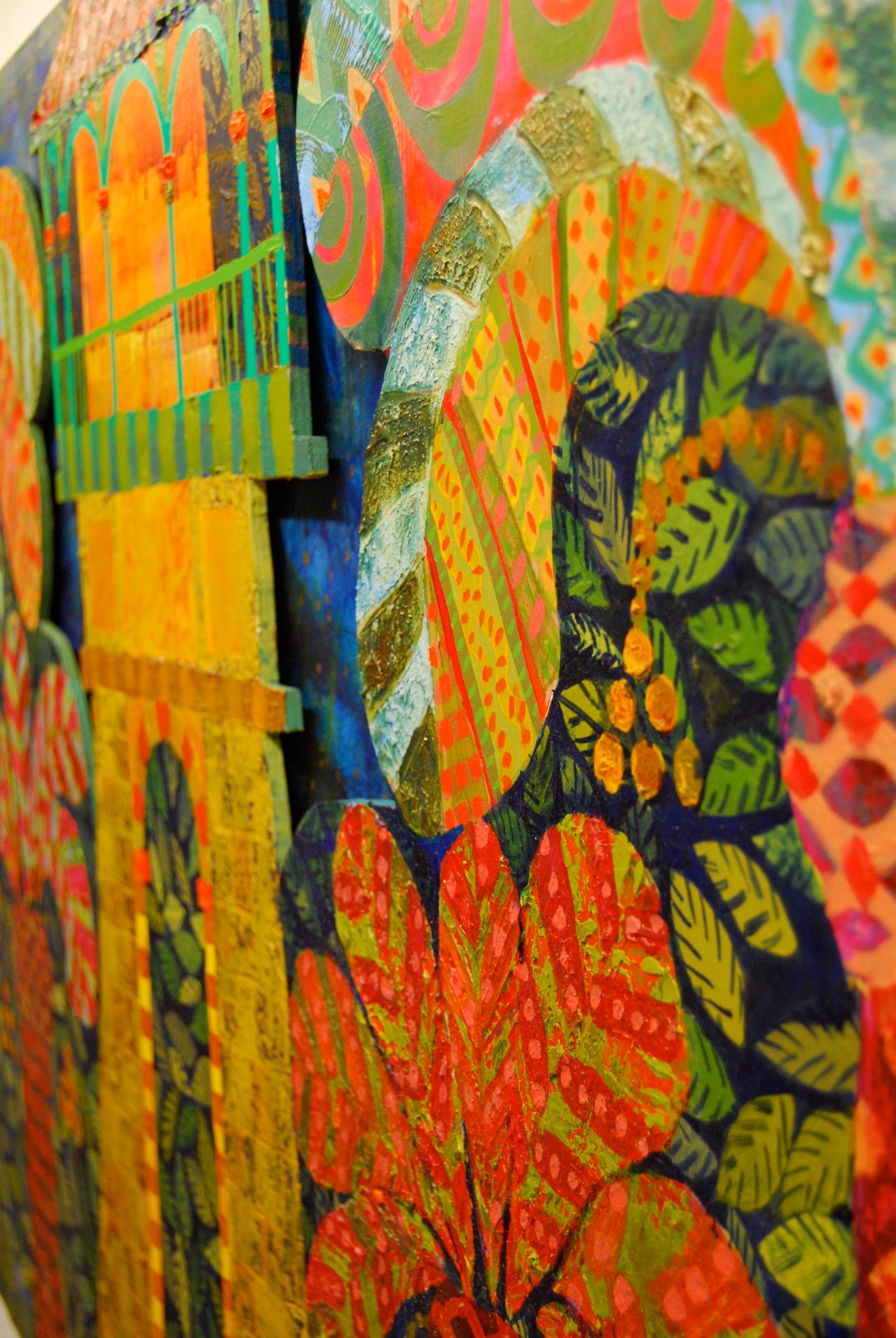
February 28, 2012
This morning while thinking in Hebrew, I noticed that the Hebrew/Aramaic word for pattern DUGMA, is almost identical to the Latin loan word DOGMA.
In November, I had the honor of meeting with Robert Zakanovitch, one of the founders of the Pattern and Decoration movement in the 1980s. We had a wonderful discussion about the various crises that Modern painting has gone through, beginning with the abstraction of figures and of observation, through the pure formalism of placing pigment on canvas with great virtuosity as was valued in the 1950s. This process of elimination, led to what many would consider to be a dead end in painting: Conceptual art, in which even the pigment is eliminated.
A love of pattern is innate in all human cultures. Creating repetitive ornament has been the most common form of visual creativity for thousands of years. Yet sometime in the Renaissance ornament fell out of favor in European art, and gradually became relegated to the lower level of handicrafts, and even worse, to be considered merely “women’s work.”
The Pattern and Decoration movement was dominated by women, more specifically Jewish women. Battling for their feminist agenda was not enough. They also had to battle with the current artistic dogmas: The very “pithy” and deliberately exclusive art establishment viewed anything “pretty” as being vulgar.
Yet “Prettiness” is not any more vulgar or simplistic, than let’s say the color blue is. Blue inspires a whole range of emotions, and when contrasted with other colors, blue can enlighten or blur new awareness. Blue can be brilliant or banal, depending upon the context. So too with visual beauty.
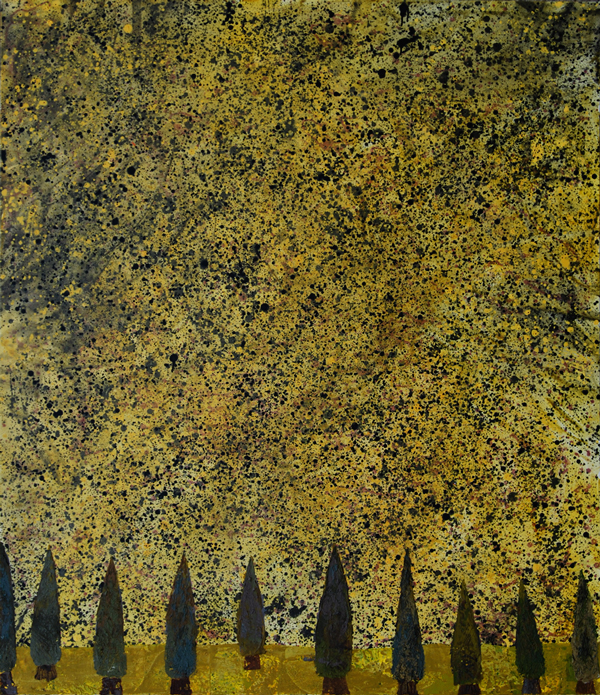
Dear Friends,
I would like to share some of my recent artwork with you.
Last May, at the opening of my show at the Jerusalem Theatre, I spoke about the border between ornament and art, and about my exploration of ornament’s potential as a vehicle for emotional and artistic expression. I have found this subject to be even deeper and more gratifying than I had imagined. While applying more and more layers to each painting, I alternatively create denser layers of pattern, or masks to hide or mutate them. Like a toddler building a tower of blocks, building, knocking down, and building again. At the same time, my own levels of raw emotions vacillate with a desire to return to a well behaved and pretty aesthetic. Like the naughty child in Sendak’s “Where the Wild Things Are”.
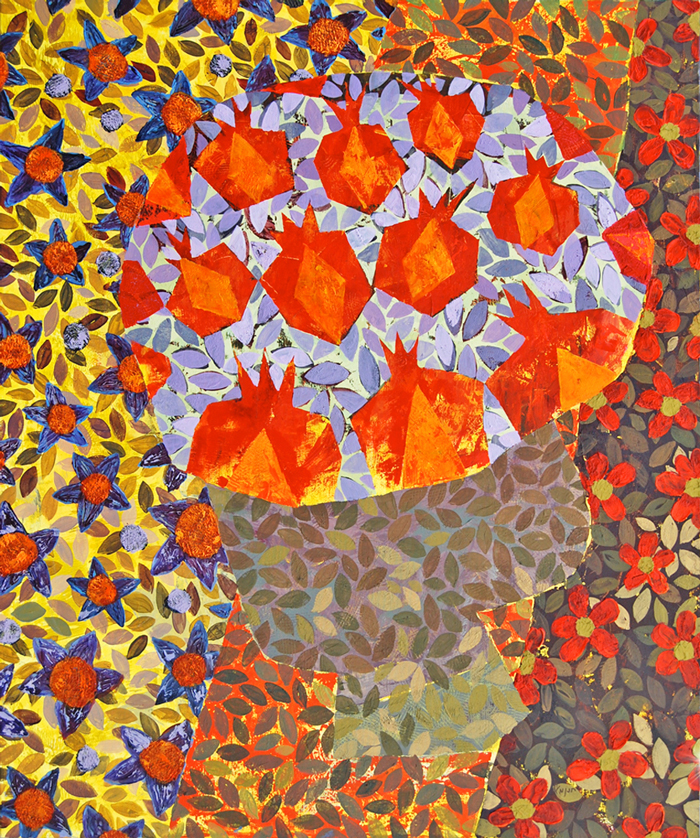
My goal is to stop working at that enigmatic point in time, when I feel that this tug of war, has reached a perfect tie: The war is between impulsive, yet engaging “bad taste” and refined, pleasing “good taste”. The moment when our tense concentration, breaks into a humorous, joyous smile.
I use the power or delicacy of pattern, to counterbalance my deliberately coarse executed of earlier layers; to correct my deliberately imperfect compositions, and to make peace with waring colors. I prefer to initially attack the canvas as quickly as possible, from my gut. Then I patiently, thoughtfully and joyfully, build up the painting to that moment of equilibrium. Perhaps we all get gratification from fixing broken things.
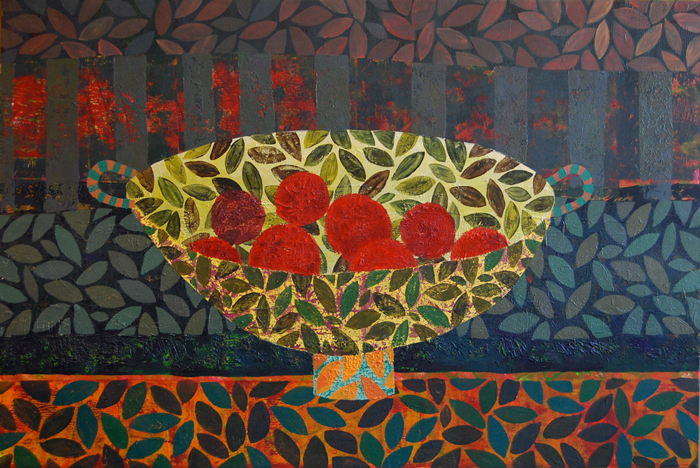
When artists paint portraits of others, in a sense they are always painting themselves. Likewise, I feel that even when painting the most neutral of objects, these works reflect my own search for self identity. Our teenage self definitions get redefined over time, as we mature, change our family and work roles, and re clarify our values.
I find that self humor is a great tool. Perhaps that is why so many of my works contain either a well balanced, symmetrically placed
object, over a joyfully chaotic undercoat, or impossibly off balanced bowls, about to roll off of the canvas.
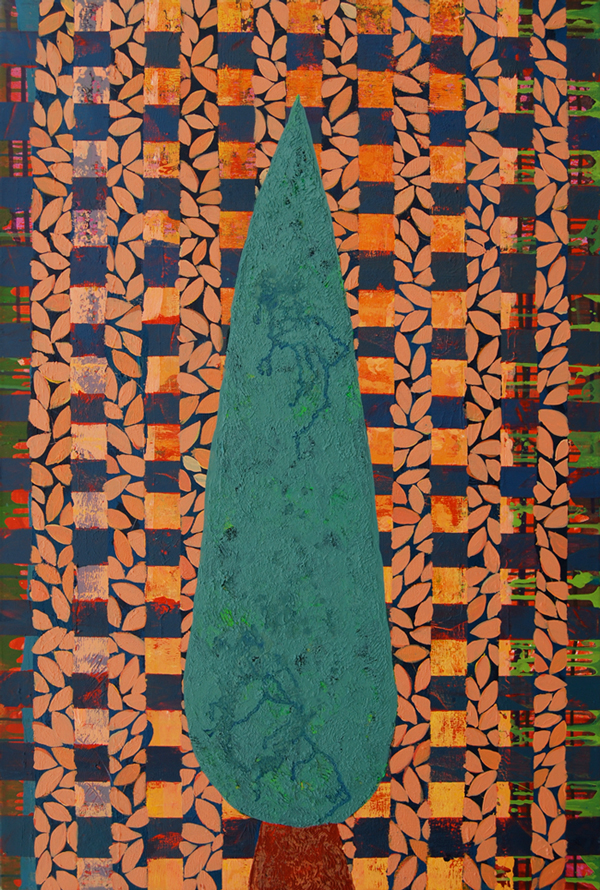
If any of you folks are here in Jerusalem, please join me at the opening of my newest exhibition:
Tuesday Feb. 21 2012, from 6 – 9 pm
at the AACI Center, 2 Poalei Zedek St. corner of Pierre Koenig, 4th floor. (across from the Hadar Mall in Talpiot)
The show will be open from Feb 2 to April 5, 2012

 Chanan Mazal | Israeli Artist